
Mediation and Global Mediation Panel


Who we are
How we help
Resources
Contact


Mediation and Global Mediation Panel
Our Office offers dedicated informal dispute resolution services to all contract holders.
What is Mediation?
Mediation Principles
Peace at Work
Global Mediation Panel
Mediation Resources
Mediation Videos
Mediation is a confidential dispute resolution process, in which a neutral third-party professional—a mediator—helps the parties in dispute to engage in a constructive conversation, discuss issues, express interests, brainstorm options, find common ground, and, where applicable, reach consensus with a view to resolving the dispute.
All mediations conducted by the Mediation Unit of the Office of the Ombudsman for United Nations Funds and Programmes are based on the four key principles of the Office: confidentiality, impartiality and neutrality, independence, and informality.
The Office also operates in accordance with the mediation principles of voluntary participation, self-determination, and informed consent.
Mediation Principles
Voluntary participation
The participation of disputing parties in mediation is voluntary, which means that the parties engage in the process voluntarily. Similarly, the parties exit from the process voluntarily. The voluntary nature of the process enables the parties to be honest and candid in communicating their own perspective, to control the process, and to achieve mutual understanding.Self-determination
The mediator will not impose any solutions on the parties. The disputing parties will have the right and power to decide the outcome of the dispute, to explore and find a solution acceptable to them. In an adjudicative process, however, such as the United Nations Dispute Tribunal or arbitration, a judge or an arbitrator will impose a binding outcome on the disputing parties.
Informed consent
During the process, the mediator will ensure that the parties understand the risks and benefits of a settlement so that they can make an informed decision.
The role of the mediator
The role of the mediator is to facilitate the discussion between the parties and to help the parties to reach a satisfactory outcome, in confidence, and in the spirit of trust. The mediator does not take sides nor judge who is right or wrong, but rather creates an opportunity for the parties to have a constructive dialogue with the professional assistance of a neutral and independent mediator.
Who can request mediation?
The members of the UNDP, UNFPA, UNICEF, UNOPS, and UN Women workforce who seek to resolve a workplace dispute are eligible to request mediation services from the Mediation Unit of the Office regardless of their contractual modality (including managers, other staff members, consultants, and interns). The Office ultimately retains the discretion to determine whether a case is appropriate for mediation. If the matter is not suitable for mediation, the Visitor may choose to discuss the issues through the ombudsman services. Any party that participates in mediation retains the right to pursue formal dispute-resolution processes.
How to request mediation?
Typically, mediation commences with a party initiating the process by sending an email to the Office at ombudsmediation@fpombudsman.org with a brief description of the situation that such party is facing. All communications with the Office, including this initial communication, are strictly confidential. Once a need for mediation is expressed and the Mediation Unit determines that mediation is appropriate, the Mediation Unit will obtain both parties’ consent to the mediation process.
Mediation Newsletters
Check the Mediation Newsletters, a unique resource available to all personnel of UNDP, UNFPA, UNICEF, UNOPS and UN Women to learn more about mediation and how it can be effectively utilized.
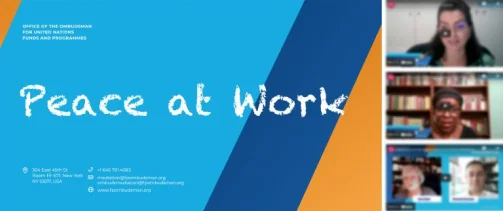
Peace at Work
The “Peace at work” project aims at producing series of short interviews with the Office of the Ombudsman’s team, the Global Mediation Panel mediators and the Board Members, and other conflict resolution professionals with the goal to provide helpful insights regarding workplace mediation. The interviews are available to all personnel of the Funds and Programmes that the Office serves and can be viewed after the registration process on our website.
Global Mediation Panel
As part of the efforts to improve the organizational culture and the ways of responding to grievances, the Office of the Ombudsman for United Nations Funds and Programmes is increasing the capacity for mediation services through its Mediation Unit. This strengthened capacity will allow staff of the five UN organizations (UNDP, UNFPA, UNICEF, UNOPS, and UN Women) to raise concerns and issues informally to a confidential, independent body, and have these issues addressed in a faster, less intrusive way.
The Mediation Unit comprises of a dedicated team of mediation practitioners that manage mediation activities and cases for UNDP, UNFPA, UNICEF, UNOPS, and UN Women.
As part of this enhanced capacity, the Office of the Ombudsman has developed a Global Mediation Panel consisting of external on-call mediators approved by the Office of the Ombudsman who will mediate workplace disputes involving the five UN organizations as they occur.
Global Mediation Panel
To view the profiles of the Mediators of the Global Mediation Panel, please register below using your official email account. If you have any questions regarding the Global Mediation Panel mediators or encounter difficulties when accessing the page, please contact the Mediation Unit.
Mediation Resources
The Code of Conduct
The purpose of this Code of Conduct is to ensure that all mediators of the Global Mediation Panel of the Office of Ombudsman for the United Nations Funds and Programmes are guided by a single set of ethical rules and principles.
A Conversation with the Mediator
The Mediation Unit has launched a series of 1.5-hour training events titled “A Conversation with the Mediator,” aimed at bringing mediation closer to the country offices despite the pandemic. “A Conversation with the Mediator” includes two components.
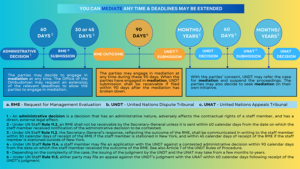
Formal Deadlines & Extension
This illustrative chart explains the relevant deadlines to formally challenge administrative decisions and opportunities to mediate at any stage.
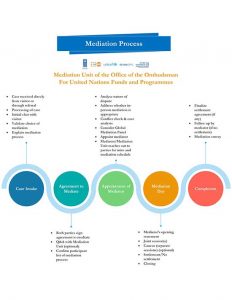
Mediation process
This document provides a useful illustrative chart to describe the mediation process and the steps involved therein.
Guide for External Lawyers
This guide is specifically designed for external lawyers who represent personnel in disputes against any of five UN funds and programmes.
Mediation Advocacy Guide
Although this guide is specifically designed for mediation lawyers and parties represented by lawyers in mediation, it can also be useful for an unrepresented party to develop a strategy to and prepare for an upcoming mediation session.
Guide for Parties on How to Prepare for Mediation
This document is specifically designed for the personnel of the five UN agencies served by the Office to guide them on the nuances of preparation for mediation.
Mediation Guide
This Mediation Guide describes the role of the Mediation Unit of the Office in supporting effective conflict resolution and collaboration among the members of the workforce, with particular focus on the enhanced capacity of the Office for timely and effective provision of top-quality mediation services.
Mediation Rules
These Mediation Rules become effective as of 1 January 2024. The Office reserves the right to modify the Rules without notice. However, the pending Mediations will continue to be subject to the Rules under which they have commenced.
Mediation Videos
Introduction to Mediation Services
CASE 1 Interpersonal & performance
CASE 2 Reorganization
CASE 3 Harassment & performance
CASE 4 Consultancy
CASE 5 Organization’s perspective on mediation
If you would like to contact the Mediation Unit, you can reach out via email:
Email: mediation@fpombudsman.org