In 2025, the Office of the Ombudsman’s work with UNDP, UNFPA, UNICEF, UNOPS and UN Women had a common thread: supporting colleagues as they dealt with sudden and far-reaching organizational changes. Funding shifts, geopolitical crises, and restructuring and relocation efforts affected personnel who had to absorb and adjust to new realities quickly.
The year 2024 was marked by numerous challenges that tested personnel’s resilience and adaptability. At the time of preparation of the 2024 annual report, moreover, 2025 has already presented an entirely new set of unprecedented challenges and significant geopolitical changes. Evolving circumstances have required the Office of the Ombudsman for UNDP, UNFPA, UNICEF, UNOPS, and UN Women (the Office) to continuously innovate and adapt its conflict-resolution methods and strategies to navigate the complexities of the global United Nations workplace landscapes.
In 2023, transitions, concurrent crises, funding pressures, hybrid work, political instability, mental-health issues, and burnout concerns impacted the workplace of UNDP, UNFPA, UNICEF, UNOPS and UN-Women (the organizations). Organizations and personnel faced heightened volatility, uncertainty, complexity, and ambiguity. The Office of the Ombudsman for UNDP, UNFPA, UNICEF, UNOPS and UN-Women (the Office) in turn expanded its outreach and field missions as well as mediation efforts. The Office noted a shift towards more people-centred human-resources management efforts across organizations, for both staff and the affiliated workforce, which recognized that complex work environments directly affect people and their lives, who in turn delivered with resilience in challenging times.
The Office of the Ombudsman for United Nations Funds and Programmes was in a period of transition during the reporting period and remains so the time of writing of the present report: two of its key professional positions, Ombudsman and Ombudsman Specialist remained vacant in 2022. Nevertheless, the Office team continued to provide dedicated services in spite of the lack of adequate staffing and wishes to extend appreciation and thanks to all management and staff of the five organizations served who demonstrated their belief and support in the Office. The cooperation and forthright spirit of resident representatives, the staff of human resources, legal, ethics, and investigation offices, in addition to staff representatives, who encouraged colleagues to make use of the services provided by the Office contributed to the overall effectiveness of informal resolution in the workplace.
As the restrictions imposed by the COVID-19 pandemic stretched into a second year in 2021, the Office of the Ombudsman for United Nations Funds and Programmes continued to serve its community by honing virtual mechanisms. It is encouraging that the ombudsman and mediation teams were able to deal effectively with an increase of 27 per cent in the number of cases brought individually and as a group to the attention of the Ombudsman. Moreover, in the outreach and training activities, the teams were able to offer virtual master classes, webinars and modules in capacity-building for conflict- management skills to a global audience in the six official languages, with some interventions tailored to specific needs raised by country offices or at the regional level. In all, the Office facilitated more than 100 virtual sessions; those offered to the Respectful Workplace Facilitators and the pilot certificate programme in conflict- management skills for leaders are particularly noteworthy.
For the Office of the Ombudsman for United Nations Funds and Programmes, as for offices around the world, the year 2020 was dominated by the COVID-19 pandemic. The active threat to the health and safety of the Office personnel, as well as to the health and safety of the global United Nations workforce, meant instituting a number of changes to office procedures and developing new ways for the Office to interact with the people it serves. Nonetheless, 2020 was a highly productive year that saw the completion of projects started in 2019, significant continuing development of conflict management, and further expansion in the development of conflict management services.
In submitting his report on the work of the Office in 2019, the Ombudsman for United Nations Funds and Programmes takes stock of a very productive year while facing the daunting challenges ahead during the time of COVID-19. In immediate response to these challenges, the Office will further strengthen interventions that draw on the possibilities of virtual communication in the continuing expansion of informal conflict resolution systems
The year in review, 2018, can be summarized in two numbers for the Office of the Ombudsman for United Nations Funds and Programmes: plus 20 per cent – the increase in the number of cases from the previous year and minus 50 per cent – the reduction in full-time professional personnel from 2017 (and continuing to the present).
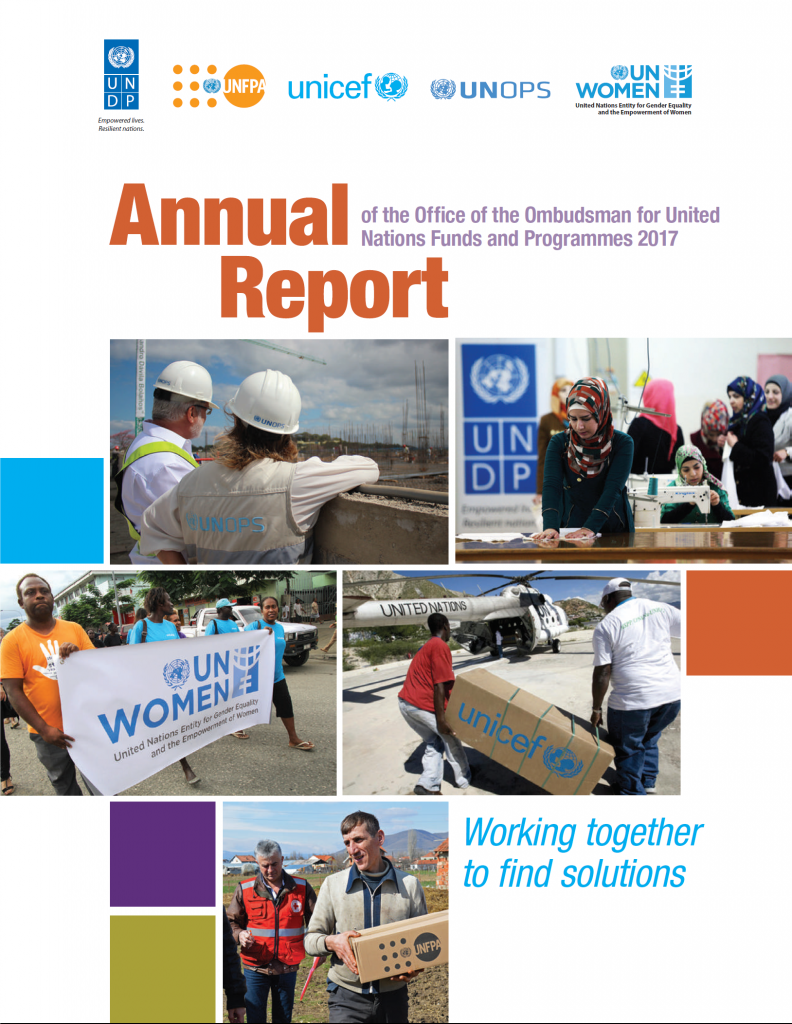
The Office of the Ombudsman for United Nations Funds and Programmes saw a momentous year in 2017. The Office has responded to the growing demand for the informal resolution of work place conflict in a number of constructive ways: by enriching its panel of conflict-resolution experts; traveling to country offices and increasing outreach and training activities in all the organizations served. and developing innovative initiatives to bring the Ombudsman closer to all contract holders in the funds and programmes.
The Office of the Ombudsman for United Nations Funds and Programmes provides informal workplace conflict resolution services to the workforce of the United Nations Development Programme (UNDP), United Nations Population Fund (UNFPA), United Nations Children’s Fund (UNICEF), United Nations Office for Project Services (UNOPS) and United Nations Entity for Gender Equality and the Empowerment of Women (UN Women).
If you are a contract holder from UNDP, UNICEF, UNFPA, UNOPS and UN Women, and need assistance on how to resolve a conflict or want help clarifying what options you have to address a dispute, get in touch with us.